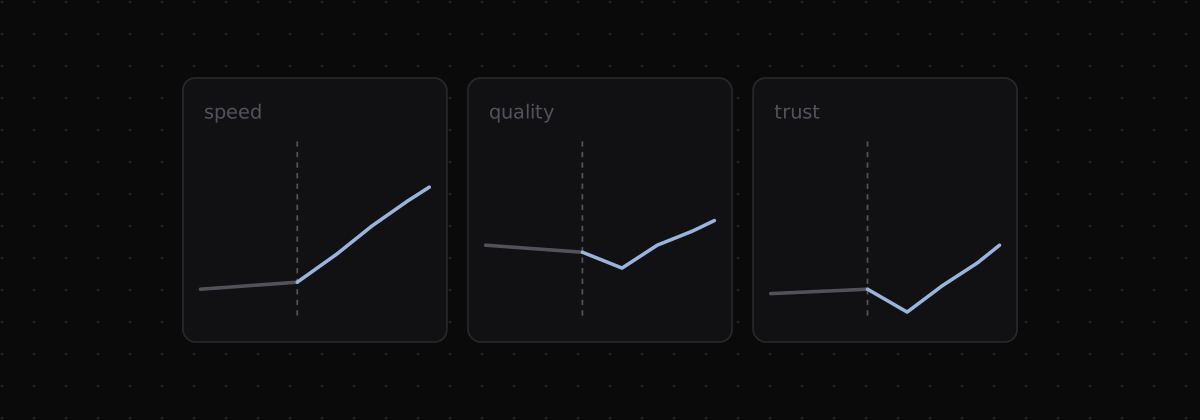
When a team adopts a coding assistant, the first signal is almost always positive: everyone feels faster, and on part of the work they really are. The trouble is that feeling fast isn’t a measurement. The rest of the cycle — review, debugging, production incidents — can get worse without anyone noticing, because nobody was watching it.
Before you start: the baseline
Before switching any tool on, collect two to four weeks of data you already have: repositories, release pipelines, the task tracker. Nothing sophisticated is needed. Without a “before”, every number that comes later is just an opinion.
Three measures, no more
- Speed: the time from first commit to release, not lines of code written.
- Quality: defects reaching production, rework, and review time.
- Trust: how often the team accepts a suggestion unchanged, and how much it trusts its reviews.
Speed is the easiest to measure and the most misleading. An assistant that produces twice the code in half the time can also double the work of whoever has to read it. That’s why quality has to be watched alongside speed, on the same dashboard, at the same frequency.
Trust is the most neglected measure. If the team accepts everything without reading, you’ve moved the risk, not reduced it. If it never accepts anything, you’re paying for a tool nobody uses. You find out by talking to people, but also by looking at how often suggestions are edited before they’re committed.
If speed goes up and you don’t look at quality, you haven’t measured: you’ve cheered.
What happens in month three
The initial excitement fades and habits settle. That’s when the numbers really matter, because novelty no longer distorts them. There are three possible decisions: extend use to the whole team, narrow it to the tasks where it works (tests, documentation, repetitive migrations), or stop. Stopping is a legitimate answer, if the data says so.
The minimum rules
Before the measures, you need a few written rules: which code and data can’t leave the company, which tools are approved and with what settings, and who must always review the critical parts by hand. The rules are what make the three months comparable, because everyone is working under the same conditions.